

From the graceful movements of the Poi to the overwhelming power of the Haka, Kapa Haka (traditional Māori performing arts) is intrinsic to New Zealand’s cultural identity. Kapa Haka means to stand in a row or rank (kapa) and dance (haka). Distinctive from other indigenous performing arts, Kapa Haka combines song, dance, expression and movement.
Issue information
Kapa Haka means to stand in a row or rank (kapa) and dance (haka). Distinctive from other indigenous performing arts, Kapa Haka combines song, dance, expression and movement. It’s an art form that takes on various disciplines, as illustrated in New Zealand Post’s stamp issue that captured the dynamism and strong cultural tradition of Kapa Haka.
Performed both ceremonially and competitively, the power of Kapa Haka to convey a range of emotions is undeniable. Every two years, the nation’s most elite Kapa Haka performers come together to compete at Te Matatini National Festival – widely regarded as the ‘premier Māori cultural performing arts festival’. Taking place in Gisborne on 16-20 February, the 2011 Te Matatini Festival attracted upwards of 30,000 participants and visitors.
The six self-adhesive stamps in this compelling issue featured stances that illustrated six aspects of Kapa Haka performance. Each team that competed at Te Matatini Festival consisted of 20 or more members and performed for 30 minutes, during which time they covered each of the six disciplines of Kapa Haka.
The groups featured on the stamps represented excellence at Te Matatini 2009 as defined by Te Matatini Society. The five teams that appear on the stamps achieved a top three overall placing, or were winners of one of the six disciplines.
A Powerful Art Form
The miniature sheet, first day cover and miniature sheet first day cover captured the essence of Te Matatini, meaning ‘the many faces’. All six stamps were displayed together, forming a complete picture of the six aspects of Kapa Haka. The miniature sheet was the only way to purchase the stamps in a gummed format.
The Presentation Pack
For the ultimate collectable, you couldn't go past the Kapa Haka 2011 presentation pack. It was the perfect way to find out more about this unique performing art, and featured powerful imagery that reflected the passion of the event. Featuring text from leading Māori academic Professor Piri Sciascia, it was a collectable to be treasured for years to come, and made a beautiful souvenir or gift. The presentation pack was also the only product containing a strip of six self-adhesive stamps.
Acknowledgements
New Zealand Post wishes to acknowledge the following for their assistance in bringing together this special stamp release.
- Te Matatini Society Incorporated ‘Te Matatini’ – particularly Selwyn Parata (Te Matatini Board Chairperson), Darrin Apanui (Executive Director National Office), Rongopai Stirling (National Office), Pauline Hopa (Steering Group member) and all board members.
- KE Design - stamps and related products.
- Performing groups that appear on stamps – Te Waka Huia, Te Iti Kahurangi, Te Whanau a Apanui, Tuhourangi-Ngati Wahiao, Whangara mai Tawhiti.
- Guest writer for the presentation pack - Professor Piri Sciascia.
Product Listing for Kapa Haka 2011
| Image | Title | Description | Price |
|---|---|---|---|
 |
SIngle Stamp |
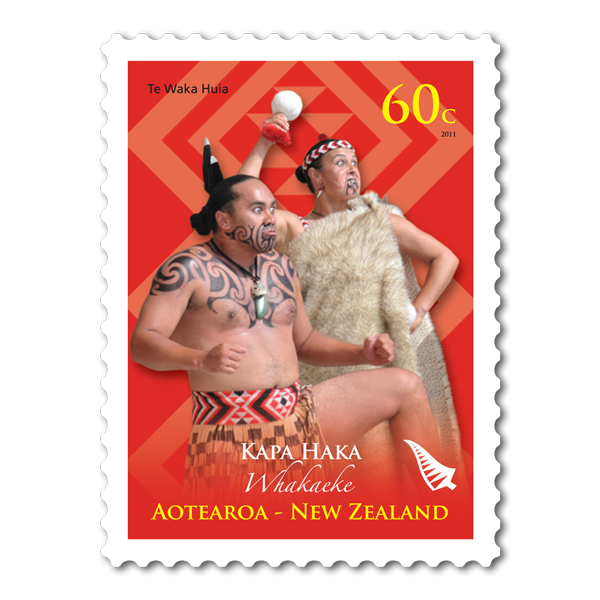
Single 60c 'Whakaeke' self-adhesive stamp. Whakaeke is a choreographed entrance onto the performance area, where elements of all disciplines are utilised. Te Waka Huia of the Tāmaki Makaurau region were the winners of Whakaeke in 2009 and placed first in the overall competition. |
$0.60 |
 |
Single Stamp |
Single 60c 'Poi' self-adhesive stamp. Poi is a graceful aspect of the Kapa Haka performance, where the dancer (usually female) swings a raupo ball on the end of a flax cord. In 2009, Te Whānau a Apanui from the Mataatua region were the winners of this discipline, and placed third overall in the competition. |
$0.60 |
 |
Single Stamp |
Single $1.20 'Waiata-ā-ringa' self-adhesive stamp. Waiata-ā-ringa are action songs, where the hands, face, eyes and body combine to bring form to the words. The 2009 winners of Waiata-ā-ringa were Te Iti Kahurangi of the Tainui region. |
$1.20 |
 |
Single Stamp |
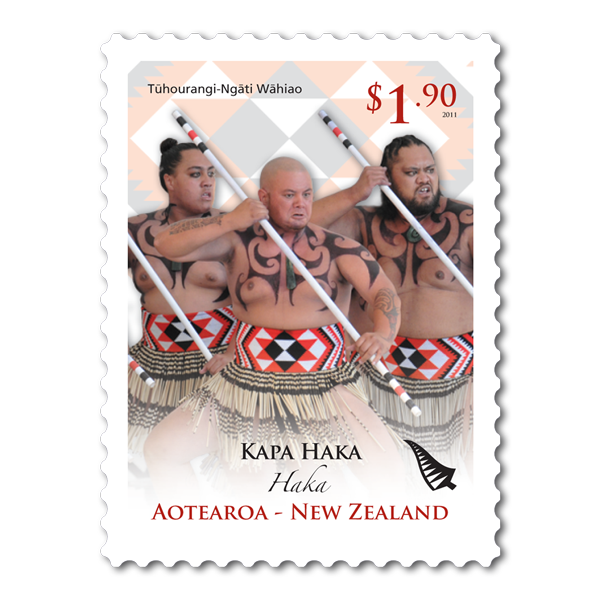
Single $1.90 'Haka' self-adhesive stamp. The Haka is the most widely known discipline, made famous worldwide by New Zealand’s sports teams. It’s an aspect of Māori culture embraced by all New Zealanders, and in 2009, Tūhourangi-Ngāti Wāhiao of the Te Arawa region were the winners of the Haka performance. |
$1.90 |
 |
Single Stamp |
Single $2.40 'Whakawātea' self-adhesive stamp. Whakawātea is a choreographed exit off the performance area, where once again elements of all disciplines are utilised. Te Waka Huia from the Tāmaki Makaurau region were also the winners of this discipline in 2009, and placed first overall. |
$2.40 |
 |
Single Stamp |
Single $2.90 'Mōteatea' self-adhesive stamp. The discipline of Mōteatea is a traditional chant, however contemporary compositions are becoming more common. In recognition of Whāngārā mai Tawhiti (from the Tairawhiti region) placing second overall in Te Matatini 2009, they featured on the Mōteatea stamp. |
$2.90 |
 |
Miniature Sheet | Mint, used or cancelled gummed miniature sheet. | $9.60 |
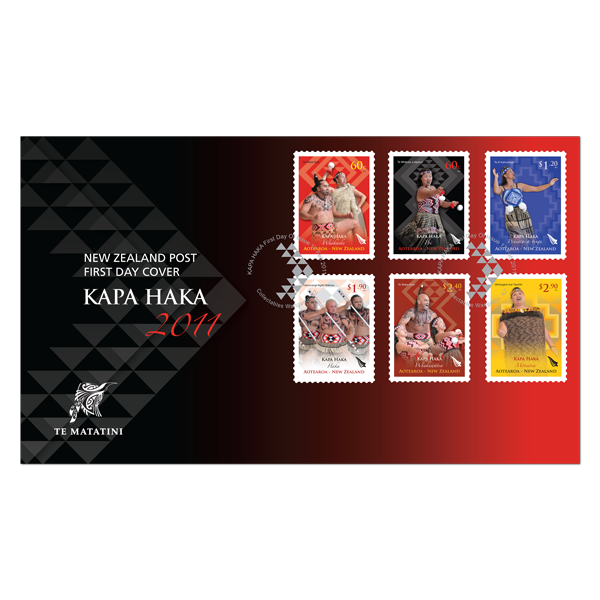 |
First Day Cover | First day cover with self-adhesive stamps affixed. Cancelled on the first day of issue. | $10.10 |
 |
Miniature Sheet First Day Cover | First day cover with miniature sheet affixed. Cancelled on the first day of issue. | $10.10 |
| Souvenir Cover | First day cover with self-adhesive stamps affixed from Gisborne launch at Te Matatini 2011. Cancelled on the first day of issue. | $10.10 | |
 |
Presentation Pack | Presentation pack which included the first day cover, miniature sheet, strip of six self-adhesive stamps and text from leading Māori academic Professor Piri Sciascia. | $29.50 |
Technical information
| Date of issue: | 17 February 2011 |
|---|---|
| Number of stamps: | Six self-adhesive stamps |
| Miniature sheet: | One sheet with six gummed stamps |
| Denominations: | 60c (x2), $1.20, $1.90, $2.40 and $2.90 |
| Stamps and first day cover designed by: | Tai Kerekere, KE Design, Wellington, New Zealand |
| Printer and process: | Southern Colour Print Ltd by offset lithography |
| Number of colours: | Four process colours |
| Stamp size and format: | 40mm x 30mm (vertical) |
| Paper type: | PSA sheets, strips, jumbo rolls and blocks printed on Avery Dennison B90 Kraft Back WLK5 Adhesive 210gsm; Gummed miniature sheets printed on Tullis Russell 104gsm red phosphor gummed stamp paper |
| Number of stamps per sheet: | 25 |
| Perforation gauge: | Gummed: 13.33 x 13.60; Self-adhesive: die-cut |
| Special blocks: | Plate/imrpint blocks could be obtained by purchasing at least six stamps from a sheet. Barcode blocks were available in A and B formats. |
| Period of sale: | These stamps remained on sale until 16 February 2012. |